Opens in a new tab
Evaluate now

Transparency Evaluation Standard (ESG Reporting)

A Scientifically Grounded Framework for Assessing ESG Reporting

The Transparency Evaluation Standard (ESG Reporting) is an assessment model developed by EUPD Research for the objective evaluation of transparency, traceability, and structural quality in ESG reporting. It forms the methodological core of the Transparency Award ESG Reporting and defines scientifically grounded benchmarks for credible, comparable sustainability communication.

The Key Performance Indicators and assessment dimensions contained in the standard are partly based on individual regulatory frameworks. They have been consolidated, harmonized, and restructured through a scientific synthesis process to ensure coherence, regulatory relevance, and international comparability. The underlying sources are continuously monitored, evaluated, and integrated into the annual update cycle to reflect regulatory developments and emerging scientific insights.

Quality Seal

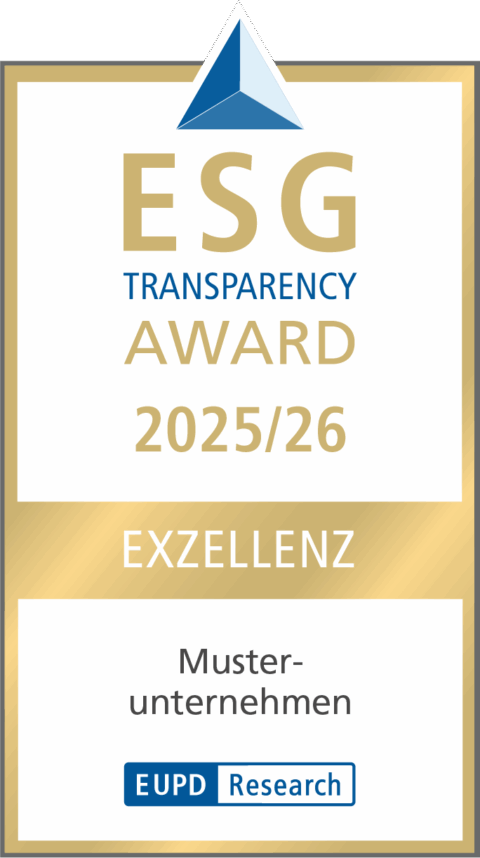
The ESG Transparency Award quality seal is more than a recognition symbol. It is a signal of credibility. It demonstrates to investors, customers, partners, and regulators that your organisation meets a verified, independently assessed standard for ESG transparency.

Award-winning organisations have the opportunity to license their verified results in the Advanced or Excellence level with the official ESG Transparency Award quality seal. The seal makes the status achieved in sustainability reporting immediately visible and supports companies in communicating their ESG transparency performance credibly and effectively.

Organisations with particularly outstanding results also have the option of licensing the Leading Company quality seal, which recognises companies with a top position in the assessment and highlights their pioneering role in transparent sustainability reporting.

What seal licensing includes:
• Seal files in various file formats for online, print and TV communication (.jpg, .eps, .png)
• Digital certificate of the quality seal
• Personal presentation of the certificate including official press photo on 24. November 2026 during European Sustainability Week
• An additional free ticket to the ESG Summit on 24. November 2026
• Quote from an ESG C-level representative of EUPD for integration into your press and public relations work

In addition, optional additional services are available as part of the seal licensing to further strengthen the public visibility of the award. These include, among others:
• Award trailer to communicate success in the ESG Transparency Award
• Individual press release to announce the award
• Social media shareables to communicate the results on relevant platforms

These additional services support organisations in making targeted use of their award in media relations, digital channels and stakeholder communication.

Award Trailer

Short film (approx. 60 seconds) with integration of a statement by the initiators, scenes of the award presentation and the editing of a short statement by your company for free use in web and social media.

Individual Press Release

Creation of an individual press template including a quote/statement from the initiators to present the pioneering role of your organisation. In addition, distribution to the media according to specialist area, sector and region as well as publication via OTS is optionally available on request.

Social Media Shareables

Creation of an individual shareable for the exclusive publication of your success on all common social media platforms LinkedIn, XING, Facebook, Instagram - others on request.

European Sustainability Week

The ESG Transparency Award will be presented to leading companies during the ESG Summit in the context of the European Sustainability Week (ESW) 2026. The ESW 2026, organized by EUPD Group, provides a unique platform to discuss the latest national and international developments in sustainability. From November 23-25, 202, industry pioneers, expert councils, and committees will come together to explore actionable solutions and drive meaningful change.

Each day combines conference sessions with Top Voices on one main stage, interactive breakout sessions, and an exhibition area for solution providers, allowing participants to discover innovative approaches, exchange ideas, and connect with peers. Learn more about the European Sustainability Week »

ASSESSMENT STRUCTURE

Evaluations under the Transparency Evaluation Standard (TES) encompass 370+ differentiated criteria distributed across five specialized clusters: Transparency, Environment, Social, Governance, and Regulatory Landscape. Each criterion is mapped to a thematic subcluster to systematically measure disclosure depth, formal rigor, and alignment with key European frameworks (including CSRD, VSME, EU Taxonomy etc.).

The cluster architecture applies a multi-dimensional methodology that evaluates double materiality disclosures (impact and financial materiality) alongside procedural transparency. Beyond verifying what data is disclosed, the framework systematically assesses disclosure logic, evidence anchoring, and the degree of contextualization required for seamless reporting.

Transparency
45 %
E
15%
G
15%
Reg.
10 %
Transparency (45 %)
E + S + G combined (45 %)
Regulatory landscape (10 %)
370+
Differentiated assessment criteria
5
Evaluation clusters
25+
Thematic subclusters
  • Reportingformat
  • Stakeholder Management
  • Value Chain 
  • Target System 
  • Methodology
  • Aussurence & Verification

Enviromental*

5 subclusters
  • Emissions and Environmental Impact
  • Resource Management
  • Waste Management
  • Biodiversity Management
  • Risk Management

Social*

5 subclusters
  • Workforce
  • Community Engagement
  • Consumer Interests
  • Working Conditions
  • Minimum Social Safeguards

Governance*

3 subclusters
  • Anti-Corruption Management
  • Business Ethics 
  • Corporate Structure
  • Reporting, Accounting, Auditing Standards
  • Laws, Directives, Regulations (EU)
  • International Frameworks, Initiatives, Agreements
  • Certifications, Ratings, Market Instruments
  • Models, Scenarios, Nature Conservation

Within the Transparency Evaluation Standard (TES), thematic subclusters serve to operationalize specific disclosure indicators across the five central clusters, enabling granular quantitative scoring while preserving thematic differentiation. Through this modular taxonomy, the standard continuously adapts to evolving European regulatory mandates (such as CSRD and VSME) without compromising historical comparability or scoring reliability.

All assessment criteria undergo an annual quality review led independently by EUPD Research to incorporate shifting regulatory requirements and technical refinements. To align the standard with real-world reporting practices, the ESG Transparency Committee provides qualitative practitioner insights and market feedback through structured surveys, maintaining strict governance firewalls to prevent any conflict of interest.

Fachliche Begleitung durch unabhängige Expertinnen und Experten

Die Qualität des Transparency Evaluation Standard (ESG Reporting) basiert auf einem kontinuierlichen fachlichen Austausch mit unabhängigen Expertinnen und Experten aus Wissenschaft, Unternehmenspraxis, Kapitalmarkt, Beratung und weiteren relevanten Stakeholdergruppen.

Im Rahmen der jährlichen Weiterentwicklung des Standards beziehen wir gezielt externe Fachperspektiven ein, um aktuelle wissenschaftliche Erkenntnisse, regulatorische Entwicklungen sowie praktische Erfahrungen in die Weiterentwicklung des Bewertungsrahmens einfließen zu lassen. Auf diese Weise stellen wir sicher, dass der Standard kontinuierlich weiterentwickelt wird und den Anforderungen einer transparenten und glaubwürdigen ESG-Berichterstattung gerecht bleibt.

Die Einbindung erfolgt über einen strukturierten Expertenprozess. Die Teilnehmenden beantworten einen fachlichen Fragebogen zu zentralen Fragestellungen transparenter ESG-Berichterstattung und bringen dabei ihre individuellen Erfahrungen und Perspektiven ein. Die eingehenden Rückmeldungen werden systematisch ausgewertet und fließen in die Überarbeitung bestehender sowie die Entwicklung neuer Bewertungskriterien ein.

Besonderen Wert legen wir auf die Unabhängigkeit der fachlichen Beiträge. Die eingebundenen Expertinnen und Experten stehen in keinem Bewertungs- oder Vergütungsverhältnis zum ESG Transparency Award. Ihre Mitwirkung erfolgt ausschließlich mit dem Ziel, die fachliche Qualität und Aktualität des ESG Transparency Evaluation Standards zu stärken.

Nachfolgend stellen wir einige der Expertinnen und Experten vor, die die Weiterentwicklung des Standards mit ihrer fachlichen Expertise eng unterstützt haben.

AT

Prof. Dr. Anabel Ternès von Hattburg

CEO, Sustain Plus · CSIO, LAVIVEE · Director, VYBE Future Institute · Founder, GetYourWings
Areas of Expertise
Sustainability, futures studies, leadership, organizational transformation, ESG innovation, and human sustainability.
Focus of Contribution
Future-oriented and human-centric aspects of ESG reporting, with a particular focus on organizational future readiness, workforce well-being, and transformational capabilities.

Prof. Dr. Anabel Ternès von Hattburg is a futurist, sustainability expert, entrepreneur, bestselling author, and TEDx speaker. As CEO of Sustain Plus and Director of VYBE Future, she advises organizations on sustainable transformation, ESG innovation, and future-oriented leadership. She serves on numerous advisory boards and supports international organizations, including the United Nations, the Club of Rome, and Plant-for-the-Planet.

“The ESG reporting of the future will not only demonstrate what organizations achieve today, but also how well they are prepared for the challenges of tomorrow. Future readiness, human sustainability, and transformational capabilities will become key indicators of sustainable value creation.”

RM

Raya Samih Makawi

Regional Leader & Executive Advisor – Government Affairs and ESG
Areas of Expertise
Strategic ESG integration, corporate sustainability, government affairs, public policy and cross-sector collaboration.
Focus of Contribution
Methodology and transparency of ESG reporting, with a particular focus on measurable social impact, strategic ESG integration, and stakeholder-oriented sustainability practices.

Raya Makawi is a regional expert, known for driving ESG transformation across diverse markets in the Middle East and Africa. With a career spanning corporate leadership and advisory roles, she has shaped high-impact sustainability agendas, strengthened institutional partnerships, and guided organizations through evolving regulatory landscapes.

In her previous role as Regional Head of Sustainability & Government Affairs at 3M, Raya led major ESG initiatives and represented the company at several global climate conferences (COP), contributing to international dialogues on sustainable development and responsible industry practices. She also served as a corporate ambassador to the UN Global Compact and other global platforms, where she engaged as a public speaker and advocate for transparent, accountable ESG performance.

“Transparent reporting is not about showing more data; it is about showing the real impact and the truth behind the data.”
AM

Dr. Anna Katharina Meyer

Co-Founder | FindingSustainia
Areas of Expertise
Sustainability governance, environmental reporting, ESG leadership development, sustainability accounting, and sustainable investment.
Focus of Contribution
Environmental reporting, sustainability governance, and the role of ESG in corporate decision-making, with a particular focus on resource allocation and investment perspectives.

Dr. Anna Katharina Meyer is a sustainability strategist and systemic facilitator with a PhD in Sustainability Accounting and an MBA in Renewables. As Co-Founder of FindingSustainia, she supports leaders in driving sustainable transformation through collaborative learning, strong networks, and systemic leadership approaches. Her expertise spans sustainability governance, strategic leadership, resilience, and sustainability accounting across the public and private sectors.

“The key question is whether sustainability is truly embedded in corporate decision-making or primarily treated as a communication exercise.”
For organisations seeking to strategically advance their reporting practice, an optional Deep Dive Analysis is available. This structured advisory service provides granular sub-cluster gap analyses, reporting maturity assessments, individual recommendations and peer best-practice benchmarks, operating as a purely optional service completely independent of award classifications or seal licensing.

Evaluation Process & Quality Assurance

Assessments under the Transparency Evaluation Standard (TES) follow a multi-stage, hybrid analytical procedure that combines AI-supported evidence extraction with expert human validation and independent third-party quality assurance.

1
Stage one

AI-Powered Evidence Extraction (NLP & RAG)

Submitted ESG reports are parsed using Retrieval-Augmented Generation (RAG) and Natural Language Processing (NLP). Operating strictly on a rule-based model without subjective interpretation, the technology identifies required disclosure items, extracts context-specific text passages, and anchors evidence to the 350+ criteria across the five ETES clusters.

NLP
RAG
Semantic classification
2
Stage two

Human-in-the-Loop Expert Validation

EUPD Research ESG analysts conduct a structured, human-in-the-loop validation of the extracted data. Following a statistically grounded Combined Sampling protocol, analysts manually audit a minimum 10% random sample alongside targeted reviews of boundary scores (e.g., transitions between Advanced and Excellence levels) and complex disclosures to ensure absolute scoring accuracy and inter-coder reliability.
ESG Analytics
Manual review
Bias elimination
3
Stage three

Independent Third-Party Audit & Governance Sign-Off

To guarantee institutional independence and repeatability, the evaluation process incorporates an external, independent third-party audit conducted by Intechnica Cert GmbH under DIN ISO/2859-1 . Operating via a remote-audit access model, independent auditors verify all licensed assessments, while a formal internal role separation (decoupling Evaluators from final Award Decision-Makers) ensures strict governance, impartiality, and audit-proof documentation.

Peer review
Reproducibility
Sample checks
All data is processed in full compliance with GDPR.

COMPARABILITY AND SCORING

Methodological comparability is ensured on two analytical levels.

Level one

Size class specific expectability

To ensure fair and market realistic comparability, a size class specific expectability is applied. Organizations are assigned to one of two size classes, namely under 1,000 and 1,000 or more employees, in line with the CSRD threshold applicable since the EU Omnibus reform (Directive 2026/470). For each size class, it is determined per assessment criterion whether a positive result can be expected with high probability in a comprehensive sustainability report.


Only criteria classified as expectable are included at full weight in the base calculation of the respective cluster. Where criteria classified as not expectable are nonetheless fulfilled positively, this additional performance is credited under the Voluntary Excellence category. This category is intended to appropriately recognize companies whose reporting goes beyond simple expectability and thereby provides even greater transparency.


Through this company size dependent expectability, structural differences between smaller and larger organizations are methodologically balanced without devaluing individual criteria relative to the respective other size class.

Level Two

Weighted aggregation

Results are aggregated at both cluster and overall level using a transparent calculation method. Individual item scores are multiplied by their respective question weights and summed at the cluster level. The overall score is derived from the weighted average of cluster results according to the defined cluster weights (45% Transparency, 45% ESG, 10% Regulatory Landscape). This procedure ensures that the evaluation reflects both absolute performance values and relative positioning within comparison groups, enabling methodologically consistent comparability across countries, industries, and size classes.

CLASSIFICATION AND AWARD LEVELS

Organizations are classified according to their overall score into the following levels:

Score Range
0 - 49%
50 - 74%
75 - 100%

The organisation is at an early stage of ESG reporting. The assessment highlights the areas where transparency already exists and where there is still room for development.

Building Foundations

The organisation has a solid foundation in sustainability reporting with a clear commitment to transparency. ESG reporting is established and covers key sustainability topics. There are still targeted areas for optimisation to further deepen reporting and make the transition to the top tier.

Advanced Reporting
Clear Commitment
Quality seal licence
The organisation demonstrates exemplary ESG reporting with a high level of transparency and comprehensive coverage across all relevant dimensions. The report meets the highest standards of completeness and comparability.
Exemplary Transparency
Outstanding Quality
Quality seal licence
The top-performing organisations per industry and size category receive the additional distinction of Leading Company, provided a minimum score is achieved. Furthermore, all organisations that achieve a score above 90% automatically receive Leading status. Leading Companies are honoured at the official award ceremony at the ESG Summit and benefit from accompanying media coverage by the EUPD Group.
ESG Summit ceremony
Media coverage
Dedicated seal
External communication

For further reading

For anyone who wants to dig deeper: the standard as a PDF.

DownloadPDF

Transparency Evaluation Standard (ESG Reporting)

Methodology, evaluation criteria and requirements of the Transparency Award ESG Reporting at a glance.

Download standard

Contact

Lou Kaiser
Head of ESG